Multimode Entanglement Characterization with Presto
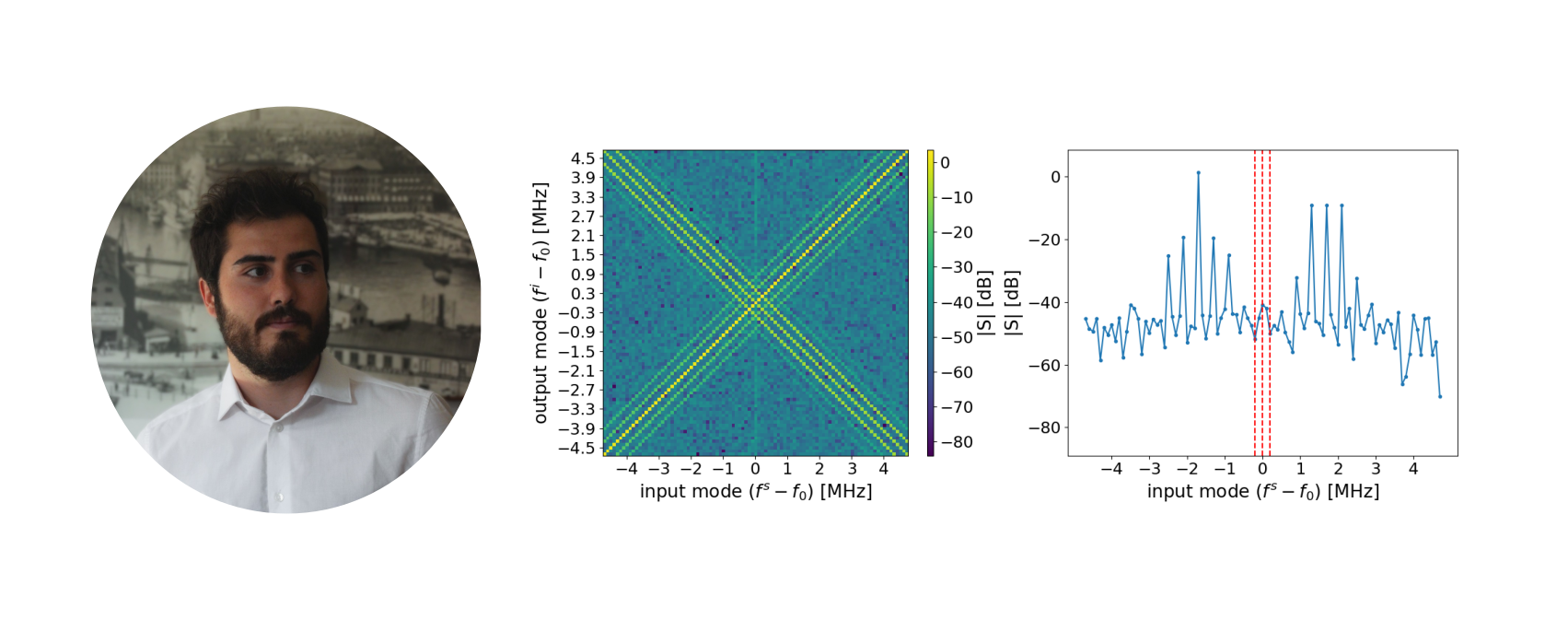 Juan Carlos Rivera Hernandez and a scattering matrix of a triple parametrically pumped Josephson Parametric Amplifier (JPA).
Introduction:
Hi, my name is Juan Carlos, and I am currently a Ph.D. Student in David Haviland's group at the Nanostructure Physics department at KTH Royal Institute of Technology. My research interests span several areas of quantum computing, including superconducting quantum computing, circuit QED, continuous variable (CV) quantum computation, and measurement-based quantum computation (MBQC). In particular, I study multipartite entanglement in microwave frequency combs generated by a Josephson parametric amplifier (JPA). To generate the quantum correlations between the different frequencies of our combs, we apply several pump tones to the JPA at double its resonant frequency. In this way, we enable three-wave mixing processes that correlate modes bouncing on the JPA. My main goal is to analyze how the quantum correlations are generated inside the JPA, entangle as many modes as possible, and eventually generate CV cluster states, a fundamental resource for MBQC.
Full phase control:
Presto allows full phase control of the pump tones and easy scalability, which are key features to engineer the quantum correlations in our system. Before Presto, I needed an arbitrary waveform generator (AWG) and a local oscillator (LO) to upconvert the pump tones at double the resonant frequency of the JPA. This AWG could only generate up to two tones with no phase control and needed to be locked to the digitizer that measures the created correlations to ensure coherence. With Presto, we can both generate and measure as many tones as we need in a coherent way. We eliminated the need for using multiple instruments, which was a source of incoherence in our system.
Simple to create frequency combs:
On top of this, Presto helped simplify stuff in the lab. Dealing with multiple frequencies is very simple with Presto. One does not need to worry about analog mixers, and you only need a few code lines to generate a frequency comb. Also, you can change the measurement bandwidth, the comb spacing and tune all the frequencies very easily, you only need to take into account Presto's bandwidth of 1 GHz.
Using the Python API:
I remember it was a bit tough when I started learning how to program Presto for my measurements (to be fair everything feels kind of difficult during the first year of your Ph.D.), but after a while it became smooth. The example scripts are quite useful and help to develop your first measurement scripts. The fact that the device is operated through a Python API really makes it simple and opens you a lot of possibilities without needing big Python skills. Moreover, it is very easy and intuitive to add complexity to your scripts. For example, you can easily add more drive tones, or perform a power sweep while doing a frequency sweep while doing a DC bias sweep while doing another sweep.
IMP Customer Support:
Since I work at KTH and IMP has offices right next to mine, I am a bit spoilt. I just need to walk next door and ask, which I do quite often. However, even though I pass by their office hundreds of times, they always find the time to help me!